 Hans Rustad
 Den gresk-ortodokse presten Ibrahim Sarrouj har en bokhandel og et bibliotek i Tripoli på 80.000 bøker. Mange av dem sjeldne. Lørdag stormet tre maskerte inn og satte fyr på bøkene.
Det var oppstått et rykte om at Sarrouj hadde skrevet et anti-islamsk skrift. Dette er tøv. Artikkelen ligger online og er flere år gammel. Men ryktet gikk. Fredag var det tema i moskeen. Politiet advarte Sarrouj og sa de skulle holde vakt.
Noen ser ut til å ha villet ta saken i egne hender.
Men ryktet kan også ha vært et cover for mer kommersielle interesser. Eierne av bygningen hvor Saeh bokhandelen holder til, har lenge ønsket at han skal flytte. De vil gjerne rive bygningen. Men Sarraouj har ingensteder å flytte.
Uansett hva motivet måtte være: brannstifting av en kristen bokhandel har ringvirkninger.
Tripoli er åsted for åpne kamper og bilbomer mellom sunnier og shiaer. Det er den sekteriske krigen i Syria som slår inn.
Heller ikke de kristne har det lett. Det går flere år tilbake, i takt med islamismens fremvekst.
Denne gangen virket brannstiftelsen som en vekker. Folk kom til for å hjelpe med å rydde opp, og fordømte vandaliseringen.
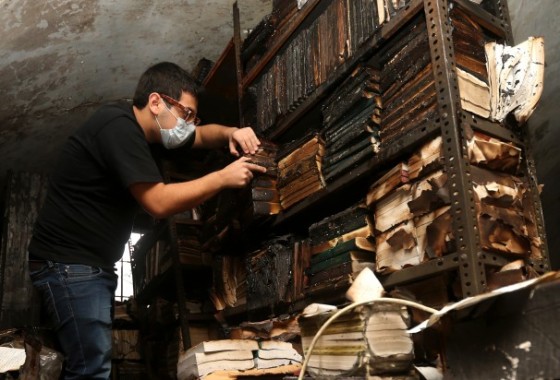
Av de 80.000 bøkene regnes 5.000 for skadd i brannen.
The shop’s most valuable items, centuries-old religious manuscripts, were mostly unharmed. They included 40 copies of the Muslim holy book, the Quran, written in delicate calligraphy, said book collector Maurice Kodeih, who was in touch with the media-shy Greek Orthodox priest who owns the shop, Ibrahim Sarrouj.
Najat Bitar, a relative of the priest, said it appeared that no more than a fifth of the shop’s’ estimated 80,000 books were burned, thanks to high humidity in the creaky building. Still, it wasn’t clear when the bookshop would reopen or the cost of the damages.
The attack was not unexpected, Bitar said. Just two days earlier, gunmen entered the shop and fired at an employee. Bitar said they called the police, who took in Sarrouj for questioning, asking him if he had written an anti-Islamic tract.
Sarrouj, who has worked for years in interfaith Muslim-Christian relations, told police it was the first he’d heard of the tract, according to Bitar. The tract in question was published years ago and can be found online.
The following day, security officials told the priest that Muslims from a nearby mosque intended to demonstrate against him. The officials assured the priest that they would prevent protesters from entering the shop. They sent soldiers, and the protest fizzled out.
..
But what was frightening, said residents, was that regardless of the arsonists’ real motives, the rumor was spread as a way of justifying the fire.